

The investment industry knows that opportunities marketed as providing favorable tax benefits elicit a strong response from investors. The prospect of reducing or even eliminating taxes can be so attractive that some investors will commit to an investment strategy without fully understanding it – what may be touted as “tax advantaged” can be interpreted as “tax free”. But there can be a difference between what investors may hear (or perhaps more accurately what they want to hear) and how these strategies actually work.
One of the most currently popular “tax-advantaged” strategies is known as Tax-Aware Long-Short (TALS) investing. This strategy is especially marketed as a means to reduce the taxes associated with a major liquidity event. But while TALS investing may create beneficial tax planning opportunities, these benefits are more nuanced than investors may expect.
TALS strategies tend to defer taxes, not eliminate them. Investing in these strategies also involves very notable trade-offs, including long holding periods, the potential for high levels of leverage, and a significant number of transactions in any given year. In this article, we’ll look at when this approach can make sense, and what questions investors should ask before committing.
How Does a TALS Strategy Work?
The most common TALS strategies currently being offered are comprised of three components. First, a TALS portfolio generally starts with core holdings of hundreds of individual equities, typically benchmarked to a major index. Then, two extensions of additional securities are added to the portfolio, funded with leverage (debt): a “short” leg and a “long” leg. In an effort to generate desired returns, the manager actively trades this portfolio.
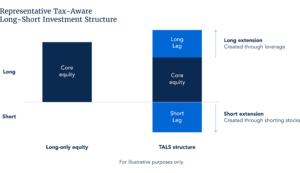
For many investors, a significant attraction is what this strategy can do for their tax bill. Through potentially hundreds or thousands of buy and sell transactions, the manager seeks to strategically harvest losses across the portfolio. To avoid the realization of gains, stocks that have appreciated in value are generally not sold.
The intended result of these transactions is to generate net realized losses, which can be used to offset a taxpayer’s gains outside of the portfolio and theoretically lower the total taxes owed in a particular year. If losses exceed all of the taxpayer’s capital gains in a tax year, the excess losses can be carried forward to future years. If net losses are realized from this strategy in a particular year, they can offset gains realized in the same tax year, such as those resulting from selling a business or reducing a highly appreciated concentrated stock position.
However, this approach tends to defer taxes, rather than eliminating them entirely. If the strategy works as designed, losing positions are promptly sold to harvest their tax value. At the end of an extended holding period, the process would likely result in a portfolio comprised mostly of positions with unrealized gains.
This can lead to a situation where the annual losses realized are reduced over time while the unrealized gains increase. As a result, investors who eventually want to reduce or unwind their TALS portfolio could be left with a substantial tax bill.
When Can a TALS Strategy Potentially Make Sense?
Although TALS strategies generally defer taxes, this approach can still carry advantages in certain situations.
For an investor who can avoid liquidating or accessing a TALS portfolio during their lifetime, it may be possible to eventually eliminate the deferred taxes. If they can manage – and are comfortable with – leaving the portfolio virtually untouched during their lifetime, the assets in the TALS portfolio will receive a “step up” in cost basis when they pass away. This can eliminate the tax obligation for their heirs.
To re-emphasize: for this outcome to be successful, the portfolio cannot be liquidated nor the strategy significantly modified during an investor’s lifetime (which likely implies retaining the manager, too). This strategy may take decades to play out. Therefore, it requires a degree of discipline and tolerance for illiquidity that most investors would find quite hard to stomach.
Alternatively, consider an investor with highly appreciated concentrated stock holdings. Should a TALS strategy generate excess losses each year, the investor can diversify their positions over time by offsetting the gains generated by selling those holdings. This can reduce concentration risk while lowering the tax cost of diversification.
Additional benefits of deferral include more time for pre-tax compounding, since money that would have been paid in taxes continues to grow in a portfolio. Under certain circumstances, losses may also be used to offset gains taxed at (higher) short-term rates, while deferred gains are paid at (lower) long-term rates. Although these potential advantages are worth understanding, they come at the expense of several trade-offs that can complicate an investor’s overall financial strategy.
Key Considerations for TALS Investing
To invest in a TALS strategy, you must be comfortable with the following considerations:
- Leverage Risk. A significant additional “L” missing from the TALS acronym is Leverage, which is typically a critical tool used in these strategies. Because many TALS strategies rely on leverage to build long and short positions in an attempt to achieve desired results, risk can be magnified, and investors must be comfortable taking on debt within their portfolio. Strategies vary by manager, but it is common for a $1 commitment from an investor to represent up to $3, and in some cases more, of gross market exposure.
- Significant Number of Transactions. These strategies are based on the execution of a sizable number of transactions, both buys and sells. Transactions can occur on a daily basis, which may be too much for some investors to bear, and may potentially result in higher trading costs.
- Significant Number of Holdings. TALS strategies generally require holding hundreds of positions at any time. When combined with frequent trading, owning so many securities raises the chance of wash sales, increasing the complexity of an investor’s tax situation (especially when other accounts are taken into consideration).
- Limited Track Record. TALS investing has only become popular over the past five years. These strategies do not have a track record across a traditional market cycle and have not been tested during periods of significant market disruption.
- “Black Box” Approach. Transactions in a TALS strategy are typically driven by a proprietary model incorporating hundreds of different signals. Investors are not usually informed precisely how the model works, making it akin to a “black box.” This can be a significant negative for investors who want to understand what they own and why trading decisions are being made
- Regulatory Uncertainty. The IRS’s “economic substance” doctrine requires that investment strategies carry a genuine, non-tax motivation. If the IRS decides to challenge the legitimacy of these approaches under this doctrine, TALS strategies may be required to alter their approach, which could compromise their intended results
- Custodial Limitations. Several major custodians have grown cautious about facilitating these strategies, taking actions such as restricting opening new accounts, increasing fees on custodial clients, limiting leverage, and implementing very high minimums1. These or further restrictions could limit the effectiveness of these strategies.
- Longer Holding Periods. These strategies typically require long holding periods for tax advantages to fully materialize. An investor who wants to access their capital sooner (due to a change in investment strategy, lifestyle needs, or other spending) may not be able to do so without undermining the objective of pursuing the strategy in the first place.
This last point is worth emphasizing, and it further underscores why TALS strategies tend to result in tax deferral, rather than true tax elimination.
Investors are often drawn to TALS strategies to mitigate the taxes generated by selling a business or selling a concentrated or illiquid asset. But unless an investor is willing to lock up their capital until they pass away (at which point assets receive a step up in basis) – which could be decades – those deferred taxes generally come due. Locking up capital in this way tends to work against the purpose of a liquidity event or the reduction of a highly concentrated asset, which is greater access to your capital.
In contrast to TALS strategies, many of the same benefits can be achieved through loss harvesting on individual securities. While there are portfolio considerations to selling out of a losing position, doing so can offer a true tax offset – not a deferral. This is a straightforward tax mitigation approach that has always been an integral part of the Azimuth portfolio management process.
Conclusion: Understanding the Trade-Offs
Investors don’t need to avoid TALS strategies outright. But investors who hear “tax advantaged” may be too willing to overlook the trade-offs these strategies impose. Before allocating, investors should ask themselves the following questions:
- Am I trying to defer or eliminate taxes? Are these assets that I need access to during my lifetime?
- Am I comfortable with the potential complexity of investing in a strategy that requires daily transactions and owning hundreds of individual securities?
- Am I comfortable with the leverage these strategies use, which can magnify losses in both up and down markets?
- Am I comfortable with the long holding periods required to realize tax benefits, which means I may not be able to access my capital without tax implications if circumstances change?
- Am I letting the tax benefits alone drive my decision? Most importantly, do I truly understand the underlying investment approach and believe that it will help me meet my portfolio objectives?
The bottom line: TALS strategies can play a role, but only in certain circumstances, and only for investors who fully understand the trade-offs. The best investment and tax strategies are the ones that align with how you actually want to use your wealth. Should you or someone you know benefit from a conversation on these topics, we encourage you to contact our office by phone or email.
1 WealthManagement.com, Schwab Imposes Stricter Limits on Tax-Aware Long-Short Accounts Link

