

Traditional asset allocation models typically reduce risk as an investor ages. This approach is designed to provide lifetime income and reduce volatility. But what about the investor who can more than comfortably cover their lifetime spending needs? Does this approach still make sense?
With reasonable assumptions, high net worth individuals and families – defined in this piece as those whose assets can more than satisfy their lifetime income needs – are typically beyond the point of worrying about achieving lifetime financial security. They have the luxury to consider longer investing time horizons, with assets ultimately passing to heirs and perhaps other beneficiaries. As such, these investors can frequently benefit from taking on more investment risk than traditional asset allocation models would suggest.
High Net Worth Individuals Can Establish More Distinct Goals
Having accumulated sufficient assets to meet their lifetime spending needs, wealthy individuals are free to pursue goals that extend beyond lifetime financial security. A helpful way to understand the prioritization of personal financial goals is to use a framework similar to Maslow’s Hierarchy of Needs. An example of this framework is shown below.
Greater assets and income enhance financial independence, allowing an individual to work toward objectives further up the hierarchy. Of course, this assumes that spending stays reasonable for their situation.
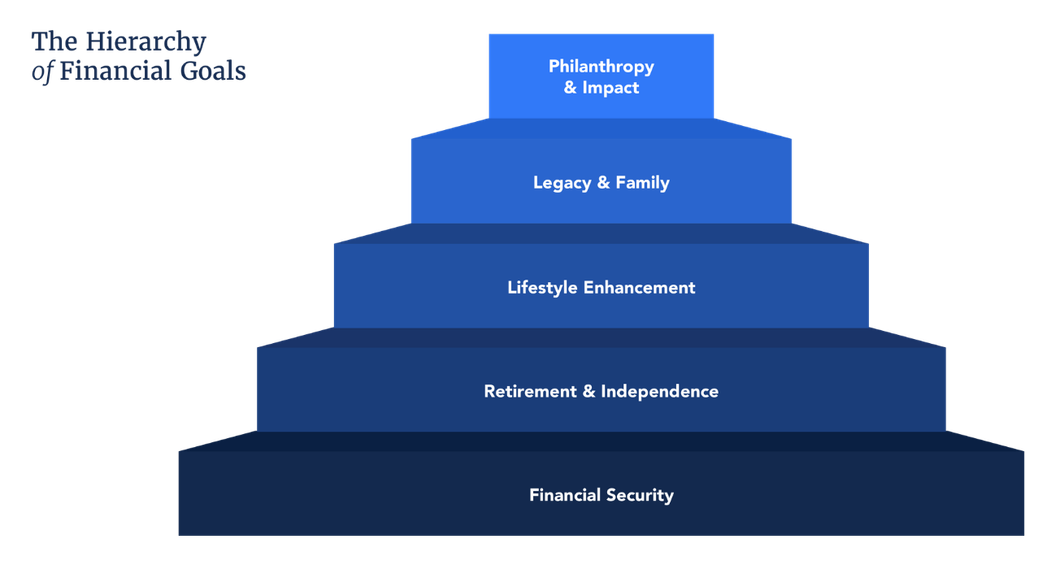
With a broader set of goals in view, the question then becomes how to best position a portfolio to pursue them. Assuming lifetime financial needs are already secured, wealthy investors can often benefit from bearing more risk in pursuit of enhanced returns to accomplish their expanded set of goals.
The Connection Between Time Horizon, Risk, and Wealth Enhancement
When you accumulate enough assets to satisfy your lifetime spending needs, a different set of financial circumstances is introduced. First, your capacity to take risk can increase. The ability to meet your spending needs through a significant market downturn should give you the confidence to maintain your investment strategy and benefit from any subsequent recovery.
Second, your planning timeline lengthens. With more significant wealth comes the opportunity to leave a meaningful estate to your heirs or charity. That means your investment portfolio can be managed for a timeline that goes beyond your own years.
Combining a longer time horizon with a higher capacity for risk means that an investor can allocate their assets more aggressively. By maintaining an aggressive allocation, high net worth investors can seek greater long-term compounding and pursue grander financial goals.
Importantly, this approach does not require a tremendous level of complexity to be effective. Even simple changes – such as maintaining a higher allocation to ‘risk’ assets like stocks – can over time make a meaningful difference. For wealthy individuals, the key is building a portfolio intentionally, rather than relying on traditional models that may not apply to their situation.
Structuring Portfolios: The Bucket Approach
Asset allocation involves assigning percentage weights across broad asset classes. Traditional models often recommend a simple allocation mix, such as the classic 60/40 (a 60% allocation to stocks and a 40% allocation to bonds). But for investors pursuing a broad set of objectives, it can be more helpful to think of assets as belonging to distinct ‘buckets’, with each bucket serving a different purpose and carrying its own percentage weights.
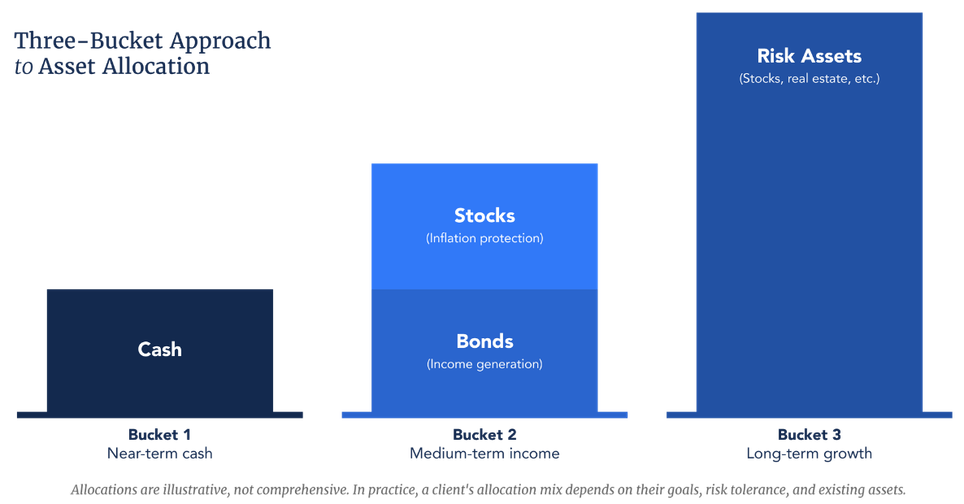
For example, a three-bucket strategy might distinguish between near-term cash needs, medium-term income, and long-term growth. This approach offers a framework for balancing different goals across distinct time horizons. Below, we walk through each bucket and the role it plays in a high net worth investor’s portfolio.
Bucket #1: Near-Term Cash Needs
The cash bucket is the most straightforward element of this approach. Its purpose is to have sufficient funds available for near-term funding needs as well as emergencies, typically keeping a reserve equivalent to 6 to 18 months of spending. Assets in this bucket are often held in low-risk cash equivalents, such as bank deposits, Treasury bills, or other forms of high-quality short-term debt.
The amount in this bucket may expand or contract depending on a client’s goals and risk tolerance. But the objective of this bucket leans more towards certainty of value and liquidity to meet needs. Thus, in our experience, it is typically not wise to invest capital in risk assets (equities or illiquid investments) that may be needed within a period of up to two years for a sizable planned expense, such as a home purchase.
Bucket #2: Medium-Term Income
The medium-term bucket generates a steady flow of income to meet day-to-day expenses and maintain a desired quality of life. This bucket may also serve to provide capital for major expenses in the next three to five years, such as a home renovation or a wedding. It’s common for this medium-term bucket to be composed of both stocks and bonds – the former for inflation protection and growth, the latter for income generation and portfolio stability.
Although traditional models typically express allocation mixes in percentage terms, high net worth individuals have the flexibility to think in dollar terms. For example, an investor might keep 5 years or more of spending power in lower risk assets such as quality bonds. Holding enough fixed income assets to cover multiple years of expenses means that an investor can avoid having to liquidate stocks during market downturns and preserve the ability to participate in potential recoveries. Looking at asset allocation through this lens also affords an investor the flexibility to be more aggressive in this bucket if desired.
Bucket #3: Long-Term Growth
Finally, the growth bucket is designed to compound wealth over the longer term, even extending into future generations or charitable goals. Depending on an individual’s income needs and level of wealth, this bucket could contain significantly more assets than the first two buckets.
To pursue growth, an individual can employ a mix of investments to seek higher returns, in line with their ability to tolerate the associated risk. In many cases, this means a dominant focus on equities and other risk assets, such as private investments. In contrast to traditional asset allocation approaches, this mix does not need to be de-risked as an investor ages, because spending needs are more than covered by the first two buckets.
Depending on the size of an investor’s estate and their personal goals, they may consider keeping a portion of this long-term growth bucket outside of their estate, with the intention of passing it down to future generations. This would enable the assets to grow free of estate taxes and benefit from a longer investment horizon.
Conclusion
Developing Your Allocation Strategy
Compared with most situations, wealthy investors typically have unique circumstances and objectives. This means that traditional allocation models – such as the standard 60/40 portfolio – may be too conservative. For these individuals and families, working with an advisor who’s experienced in serving this demographic, including navigating multigenerational estate plans and implementing applicable asset allocation strategies, can help them achieve their goals more efficiently.
The ‘right’ asset allocation is unique to every investor. In addition to financial factors, behavioral elements like risk tolerance, biases, and a preference for self-reliance over inherited wealth can also impact portfolio decisions. As you consider your own situation, it can be helpful to think through the following questions:
- Beyond funding lifestyle needs, what goals matter most to you? (e.g., business succession, legacy, philanthropy.)
- How would you bucket the investment time horizons for your various assets? (Are you planning for the next generation? Multiple generations?)
- How comfortable are you with portfolio volatility in pursuit of capital appreciation? (The answer might include both financial and psychological considerations.)
Should you or someone you know benefit from a discussion about the topics in this article, we invite you to contact our office by phone or email.